
Road quality is one of the most important indicators of transportation efficiency, safety, and user satisfaction. While potholes and cracks are visible signs of deterioration, road roughness often develops gradually and can significantly impact vehicle performance, fuel consumption, ride comfort, and maintenance costs.
To ensure consistent assessment of pavement quality across India, the Indian Roads Congress introduced IRC SP:16-2019, a comprehensive guideline for measuring and evaluating road roughness. The standard helps highway authorities, consultants, and contractors adopt uniform methodologies for automated pavement performance monitoring and maintenance planning.
As the saying goes, "A smooth road carries more than vehicles—it carries economic growth."
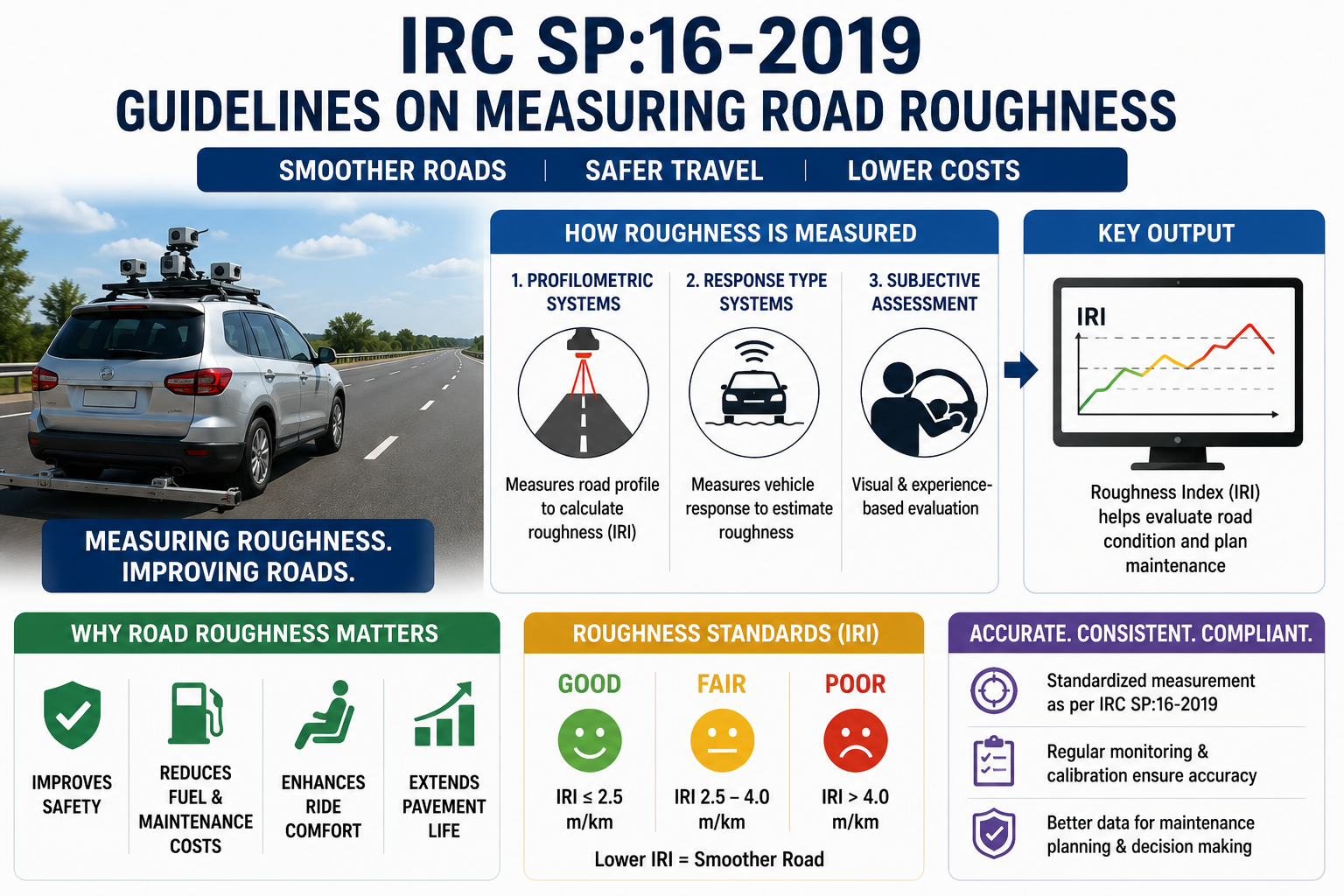
Road roughness refers to the irregularities and deviations present on a pavement surface that affect vehicle movement and ride quality.
Poor pavement smoothness can lead to:
Modern AI pavement condition monitoring solutions now help authorities continuously evaluate pavement performance across extensive highway networks without relying solely on manual surveys.
IRC SP:16-2019 provides standardized procedures for measuring, analyzing, and reporting pavement roughness on Indian roads.
The guideline serves multiple objectives:
The latest revision incorporates advances in sensor technologies, digital surveying systems, and pavement evaluation methodologies.
Road roughness is defined as the deviations of a pavement surface from an ideal smooth profile.
These irregularities may result from:
Even minor surface irregularities can significantly influence vehicle dynamics and user experience.
Today, road roughness measurement AI dashcam India technologies are making large-scale pavement evaluations faster, safer, and more cost-effective.
Road smoothness directly affects transportation efficiency.
Smoother pavements help:
For highway authorities, maintaining smooth pavement surfaces can significantly reduce lifecycle maintenance expenses.
Excessive roughness can affect:
Continuous monitoring using AI-powered IRI pavement condition monitoring enables authorities to identify deteriorating sections before they become safety hazards.
Passengers experience smoother travel on well-maintained pavements.
Benefits include:
Ride quality remains one of the most visible indicators of highway performance.
IRC SP:16-2019 categorizes roughness measurement techniques into several groups.
Profilometric systems measure the actual pavement profile and calculate roughness indices with high accuracy.
These systems are commonly used for:
Many modern International Roughness Index AI survey India solutions use advanced imaging and sensor technologies to automate profile collection.
These systems estimate roughness by measuring vehicle suspension movements while travelling over pavement surfaces.
Advantages include:
They remain widely used for large-scale pavement monitoring projects.
In some situations, trained evaluators may assess ride quality based on driving experience and visual observations.
While useful for preliminary inspections, subjective evaluations are generally supplemented by instrument-based measurements for accuracy.
The International Roughness Index (IRI) is the globally accepted standard for evaluating pavement smoothness.
IRI provides:
Today, IRI pavement quality index MoRTH NHAI assessments play a critical role in highway acceptance and maintenance programs.
Advanced AI systems can now calculate IRI values using vehicle-mounted cameras and sensor fusion technologies.
IRC SP:16-2019 establishes acceptable roughness limits for different categories of roads.
Road conditions are generally classified as:
These classifications help agencies:
Using AI road condition survey roughness India platforms enables authorities to generate condition maps automatically across entire road networks.
Accurate roughness evaluation depends on systematic data collection and analysis.
Key requirements include:
Modern automated pavement roughness index assessment systems significantly improve data accuracy while reducing field survey costs.
Reliable measurements require periodic calibration of all survey equipment.
IRC SP:16-2019 recommends:
Proper calibration ensures that pavement condition data remains accurate and defensible for engineering decisions.
Traditional roughness surveys often require specialized equipment, dedicated survey vehicles, and extensive field operations.
Modern AI-powered solutions are transforming this process through:
Technologies such as road texture depth measurement AI and computer vision-based pavement analytics enable agencies to monitor thousands of kilometres of roadway more efficiently than ever before.
RoadVision AI helps infrastructure agencies modernize pavement monitoring through advanced artificial intelligence and computer vision technologies.
The platform supports:
Using onboard cameras and AI analytics, RoadVision AI enables highway authorities to identify deteriorating road sections early, reduce inspection costs, and improve infrastructure performance.
IRC SP:16-2019 provides the foundation for standardized road roughness measurement and pavement performance evaluation in India. By establishing uniform methodologies for roughness assessment, the guideline helps engineers make informed maintenance decisions, improve road quality, and optimize infrastructure investments.
As India's road network continues to expand, combining IRC-compliant practices with digital technologies such as highway road inspection technology and digital road asset inspection solutions will become increasingly important.
Because smoother roads don't just improve travel—they improve safety, sustainability, and economic productivity.
Want to automate pavement condition monitoring and roughness assessment across your road network?
Book a demo with RoadVision AI today and discover how AI-powered pavement analytics can help your organization improve compliance, optimize maintenance budgets, and build safer, smoother roads.
IRC SP:16-2019 is the Indian Roads Congress guideline that standardizes methods for measuring, analyzing, and reporting road roughness on highway pavements.
IRI is a globally recognized pavement performance indicator that measures road smoothness and ride quality. It is widely used for pavement evaluation and maintenance planning.
AI-powered pavement monitoring systems use cameras, sensors, and computer vision algorithms to automatically assess pavement conditions, calculate roughness indicators, and identify maintenance priorities across large road networks.

The Autonomous Road Engineer
AI-powered road condition monitoring, asset management, & infrastructure intelligence helping agencies move from reactive maintenance to predictive road management.


.webp)
.webp)
.webp)