
Road construction, maintenance activities, emergency incidents, and temporary traffic diversions can significantly disrupt normal traffic flow. Without proper communication, drivers may encounter sudden lane closures, unexpected hazards, or confusing detours that increase the risk of accidents.
To address these challenges, the Indian Roads Congress introduced guidelines under IRC SP 55 Portable Variable Message Signs, establishing best practices for deploying dynamic traffic messaging systems in work zones and temporary traffic management environments.
Today, these systems are evolving beyond simple electronic signboards. Modern authorities increasingly combine Portable Variable Message Signs with AI road asset inventory VMS inspection, dynamic road sign AI monitoring India, and intelligent transportation systems to improve safety, efficiency, and operational responsiveness.
As the saying goes, "Good information prevents bad decisions." On busy highways, timely information can save lives.
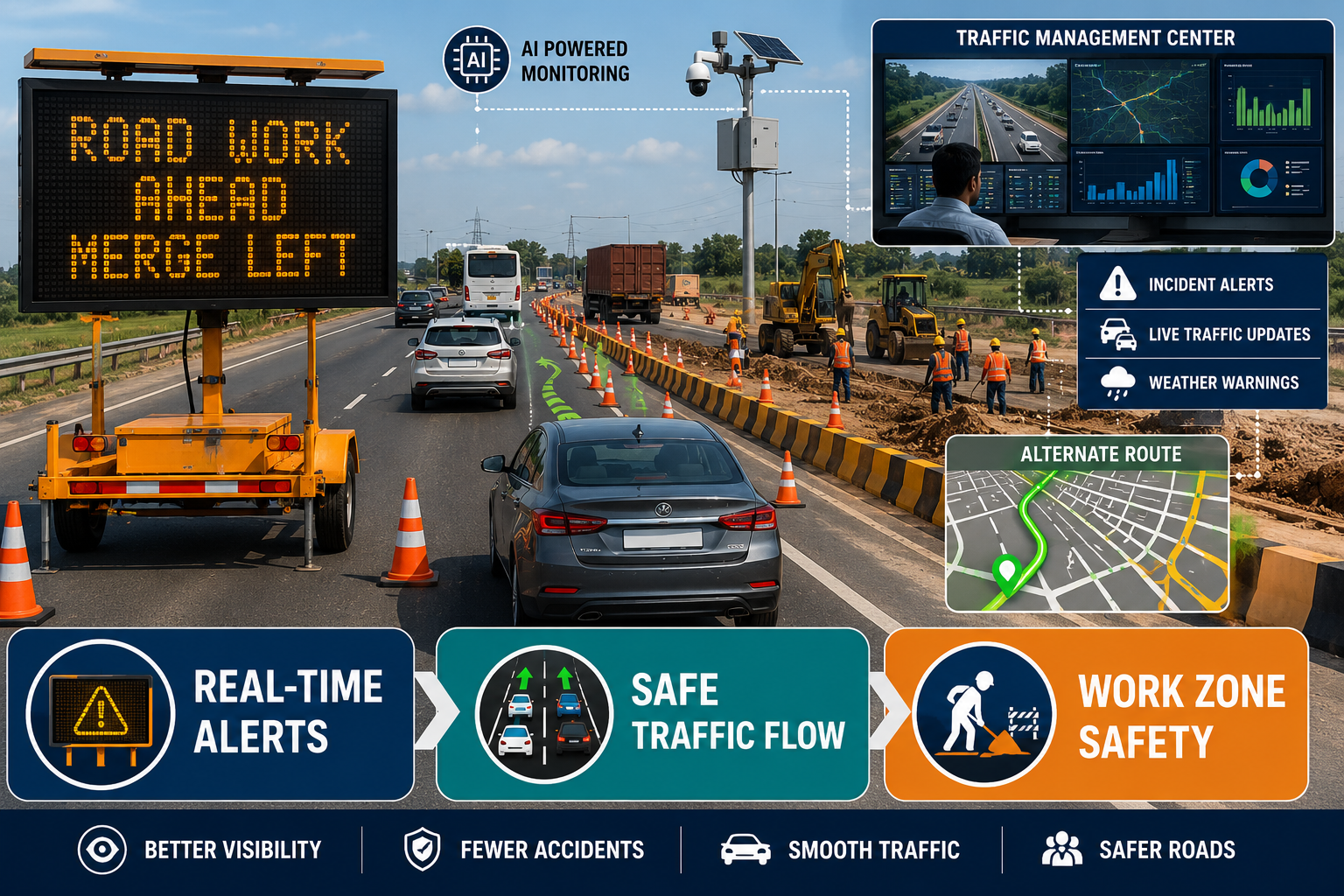
Portable Variable Message Signs (PVMS) are electronic roadside displays capable of presenting real-time traffic information, warnings, and instructions to road users.
Unlike traditional static signs, PVMS can be updated instantly to reflect changing road conditions.
These mobile systems are commonly mounted on:
Their flexibility allows authorities to deploy them wherever traffic conditions require immediate communication.
Road users often make decisions within seconds. Clear, timely information helps drivers react safely and avoid hazardous situations.
Portable Variable Message Signs contribute to:
By communicating changing conditions in real time, PVMS helps eliminate uncertainty and improve driver confidence.
PVMS can display dynamic information such as:
This enables drivers to make informed route choices before reaching affected areas.
Modern intelligent transport system VMS India deployments increasingly integrate traffic sensors and AI-powered monitoring to automate these updates.
Construction and maintenance activities create temporary hazards that require additional driver attention.
PVMS provide advance warnings such as:
These early notifications reduce sudden braking, erratic lane changes, and confusion near work zones.
Proper communication is often the first line of defence against work-zone-related crashes.
During road closures or maintenance activities, PVMS assists in directing vehicles toward alternative routes.
Benefits include:
This capability is particularly important during large-scale highway upgrades and urban infrastructure projects.
During incidents such as:
PVMS provide immediate communication to approaching motorists.
Real-time alerts help reduce secondary collisions and improve emergency response effectiveness.
PVMS reinforce compliance with temporary traffic regulations by displaying:
Studies consistently show that drivers respond more effectively to visible and dynamic messaging compared with static signage alone.
IRC SP 55 recommends positioning PVMS:
Adequate advance notice gives drivers sufficient time to react safely.
Messages should be:
Examples include:
Complex or lengthy messages should be avoided.
Effective PVMS operation depends on:
Clear readability ensures messages remain effective under varying environmental conditions.
Modern traffic authorities increasingly connect PVMS to centralized traffic control systems.
This allows:
The integration of variable message sign compliance monitoring AI solutions further improves operational reliability and maintenance planning.
While highly effective, Portable Variable Message Signs face several operational challenges.
Too much information can overwhelm drivers.
The solution is maintaining concise and standardized messaging formats.
Heavy rain, dust, glare, and fog may reduce visibility.
Adaptive brightness systems help maintain readability in changing conditions.
Electronic displays require routine inspection and maintenance to ensure reliability.
This is where AI ITS road sign asset management India solutions are increasingly supporting transportation agencies.
Traditional inspection methods often rely on periodic manual reviews of traffic assets.
Today, agencies are leveraging:
These technologies enable continuous monitoring of:
By automating inspections, authorities can improve asset reliability while reducing operational costs.
RoadVision AI helps agencies manage roadside infrastructure more efficiently through AI-powered inspection and analytics.
Capabilities include:
Using computer vision and advanced analytics, RoadVision AI enables transportation authorities to maintain safer and more reliable traffic control systems at scale.
Portable Variable Message Signs have become an essential component of modern traffic management. Under IRC SP 55 Portable Variable Message Signs, transportation agencies have a clear framework for deploying dynamic communication systems that improve safety, reduce congestion, and enhance driver awareness.
As highway networks become increasingly connected, technologies such as AI road asset inventory VMS inspection, and intelligent transport system VMS India are transforming how roadside assets are managed and maintained.
The future of work zone safety is not just about warning drivers—it is about delivering the right information at the right time.
Because safer journeys begin with better communication.
Looking to modernize traffic asset management and roadside infrastructure monitoring? RoadVision AI helps highway authorities, contractors, and infrastructure agencies automate traffic sign inspections, monitor roadside assets, and improve compliance through AI-powered analytics. Book a demo today to see how intelligent road asset monitoring can strengthen safety and operational efficiency across your network.
A Portable Variable Message Sign is a mobile electronic display used to communicate real-time traffic information, work zone warnings, diversions, and safety messages to road users.
IRC SP 55 provides guidelines on the placement, visibility, messaging, and deployment of Portable Variable Message Signs to ensure safe and effective traffic management in temporary work zones.
AI can automate roadside asset inspections, monitor sign condition, verify placement compliance, detect equipment faults, and support real-time traffic communication through intelligent transportation systems.
The Autonomous Road Engineer
AI-powered road condition monitoring, asset management, & infrastructure intelligence helping agencies move from reactive maintenance to predictive road management.


.webp)
.webp)
.webp)