
Intersections are among the most critical and high-risk components of any road network. While they facilitate movement between roads and improve connectivity, they also create numerous conflict points where vehicles, cyclists, and pedestrians interact. According to the Australian road safety framework and Austroads intersection design guidelines, a significant proportion of urban crashes occur at or near intersections, making their design and management a top priority for road authorities.
As Australia continues investing in safer transport infrastructure, modern intersection design increasingly combines engineering principles with AI road safety audits, intelligent monitoring systems, and data-driven risk assessment tools to reduce crashes and improve mobility outcomes.
After all, a well-designed intersection can mean the difference between a near miss and a serious collision.
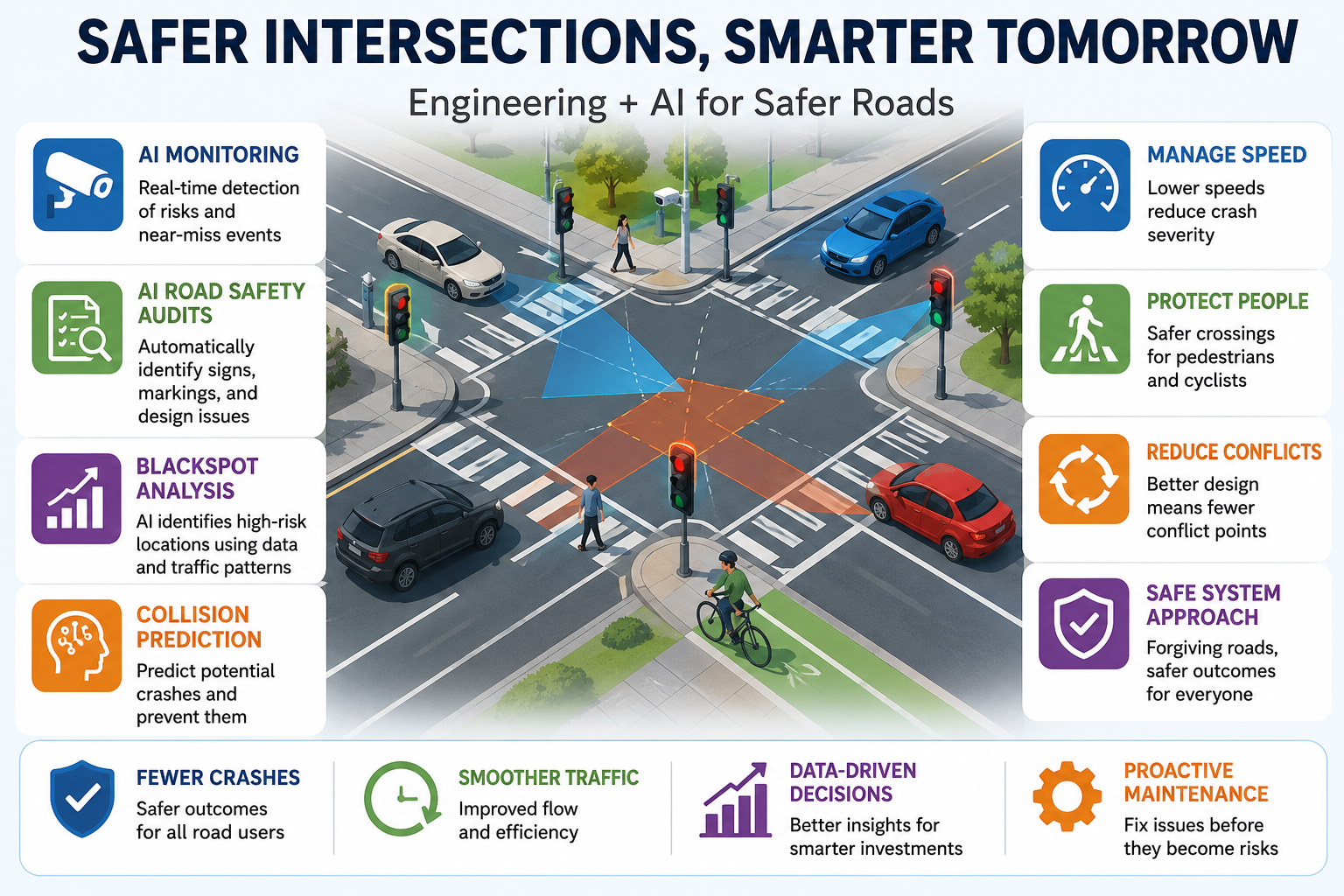
Every intersection introduces multiple decision points where road users must assess speed, priority, visibility, and traffic movements. These complex interactions increase the likelihood of crashes if the intersection is poorly designed or inadequately controlled.
Common intersection-related crash types include:
As traffic volumes increase across Australian cities, improving intersection road safety Australia AI initiatives has become essential for reducing fatalities and serious injuries.
Vehicle speed is one of the most significant factors affecting crash severity. Higher approach speeds reduce driver reaction time and increase stopping distances.
Modern intersection design focuses on:
Lower speeds create safer outcomes for all road users, particularly pedestrians and cyclists.
Drivers must be able to clearly identify:
Adequate sight distance allows drivers to make safe decisions and reduces the likelihood of sudden manoeuvres.
The complexity of an intersection directly affects crash risk.
For example:
Reducing conflict points is a key objective of modern road safety engineering.
Even well-designed intersections must account for human limitations such as:
The Safe System approach acknowledges that people make mistakes and seeks to design roads that minimise the consequences of those errors.
Traffic signals regulate vehicle and pedestrian movements by allocating right-of-way at different times.
Benefits include:
Modern smart intersection monitoring system AI solutions can optimise signal timing using real-time traffic conditions.
Roundabouts are widely recognised for improving safety by reducing vehicle speeds and eliminating severe right-angle crashes.
Advantages include:
They are particularly effective where traffic volumes are moderate and balanced.
These intersections use:
They are typically used in lower-volume environments where full signalisation is not required.
However, driver compliance and visibility become critical safety factors.
Australia's national road safety strategy is built around the Safe System philosophy, which recognises that human error is inevitable.
The approach focuses on four key pillars:
Road infrastructure should be forgiving and reduce the consequences of mistakes.
Impact speeds should remain within survivable limits.
Modern vehicle technologies should help prevent crashes and protect occupants.
Road users should be encouraged and supported to make safer decisions.
When applied to intersections, these principles significantly improve safety performance across the network.
Proper geometric design reduces confusion and improves traffic operations.
Key treatments include:
These treatments align with road safety audit best practices Australia recommendations and help reduce collision risk.
Controlling vehicle speed near intersections remains one of the most effective safety interventions.
Common measures include:
These features naturally encourage safer driving behaviour.
Protecting vulnerable road users is a fundamental objective of modern intersection design.
Common treatments include:
Advanced computer vision pedestrian intersection detection systems can further improve safety by identifying pedestrian movements in real time.
Artificial intelligence is rapidly changing how road authorities monitor and improve intersections.
Traditional road safety audits rely heavily on manual inspections and field surveys.
Today, AI road safety inspection platforms can automatically identify:
This improves efficiency and consistency across large road networks.
Modern automated intersection safety monitoring Australia systems use cameras and computer vision algorithms to analyse traffic behaviour continuously.
They can detect:
These insights enable proactive intervention before serious crashes occur.
Rather than waiting for crashes to happen, authorities increasingly use AI-based accident blackspot analysis Australia to identify emerging high-risk locations.
AI evaluates:
This helps prioritise safety investments where they can have the greatest impact.
Advanced AI collision prediction models analyse traffic interactions and identify situations that may lead to future crashes.
These systems support:
Modern road authorities increasingly rely on GIS road asset management Australia systems to manage intersection infrastructure.
GIS platforms provide:
Combined with AI infrastructure safety analysis, these tools create a comprehensive view of network performance and safety.
RoadVision AI helps transport agencies improve intersection safety through:
By combining computer vision, machine learning, and geospatial analytics, RoadVision AI enables authorities to identify risks faster and make more informed infrastructure decisions.
Intersections remain one of the most challenging environments within any road network. Their complexity demands careful planning, robust engineering standards, and continuous monitoring.
By applying Austroads intersection design guidelines, Safe System principles, and emerging technologies such as urban road monitoring AI Australia, transport agencies can significantly reduce crash risks while improving traffic efficiency.
The future of intersection safety lies in combining proven engineering practices with intelligent technologies that can continuously monitor, analyse, and improve road performance.
As Australia's road networks continue to evolve, AI-powered safety solutions will play an increasingly important role in creating safer journeys for every road user.
Don't wait for accidents to reveal hidden risks. Book a free RoadVision AI demo today and learn how automated intersection safety audits, AI collision risk detection, and real-time infrastructure monitoring can help create safer roads for every road user.
AI-powered road audits automatically detect infrastructure issues such as missing signs, faded markings, visibility problems, and potential conflict points, allowing authorities to address risks before crashes occur.
Roundabouts are generally considered among the safest intersection forms because they reduce vehicle speeds and eliminate many severe right-angle collision opportunities.
AI systems analyse crash history, traffic patterns, road geometry, and behavioural data to identify high-risk locations and predict where future crashes are most likely to occur, enabling proactive safety improvements.
The Autonomous Road Engineer
AI-powered road condition monitoring, asset management, & infrastructure intelligence helping agencies move from reactive maintenance to predictive road management.


.webp)
.webp)
.webp)