
Road maintenance is critical for preserving the safety, performance, and lifespan of India's road network. However, maintenance activities often take place in live traffic environments, exposing workers and road users to significant risks. To address these challenges, IRC Code 82 – Code of Practice for Maintenance of Bituminous Road Surfaces provides a structured framework for maintaining asphalt roads while ensuring strict safety standards.
As road agencies increasingly adopt AI road maintenance safety monitoring India solutions and automated work zone incident detection, the principles outlined in IRC Code 82 remain highly relevant for improving operational safety and compliance.
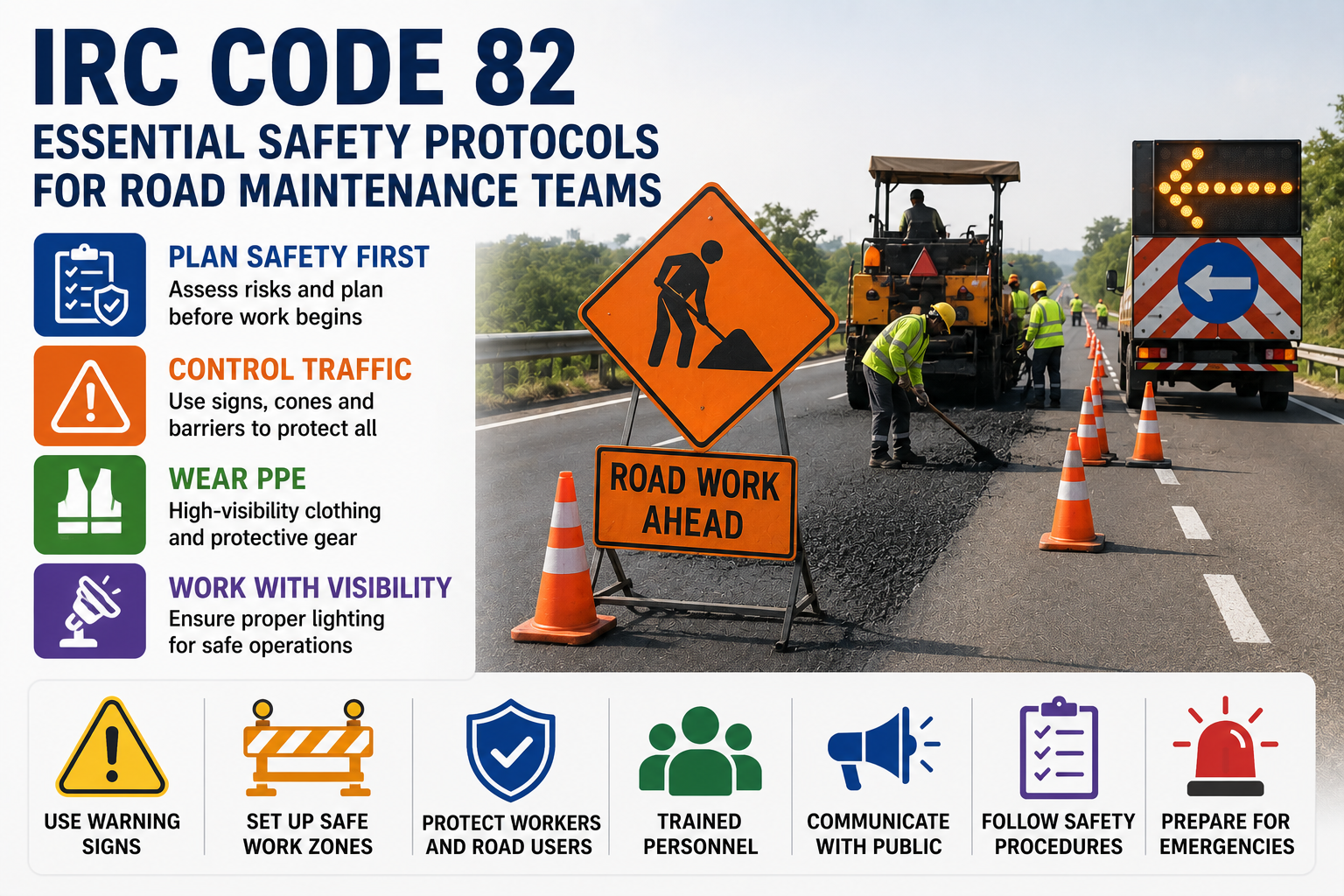
IRC Code 82 establishes best practices for the inspection, repair, and maintenance of bituminous roads. While the code covers technical maintenance procedures, it also places strong emphasis on protecting maintenance personnel through proper planning, traffic management, and work zone safety measures.
The guidelines support safer maintenance operations by reducing worker exposure to traffic hazards and ensuring that road users receive adequate warnings about ongoing work.
India's highways and urban roads carry millions of vehicles daily. Maintenance activities such as pothole repairs, crack sealing, resurfacing, and patching often occur close to moving traffic, creating significant safety challenges.
To reduce accidents, road authorities are increasingly combining IRC requirements with work zone safety compliance AI India systems, AI worker safety detection road construction technologies, and intelligent monitoring platforms that help identify hazards in real time.
Before any maintenance activity begins, a detailed safety assessment should be conducted. This includes evaluating traffic conditions, identifying potential hazards, and developing appropriate traffic management strategies.
Modern AI work zone safety audit India platforms can assist engineers by analyzing traffic patterns, identifying high-risk locations, and improving maintenance planning.
One of the most important requirements under IRC Code 82 is effective traffic control around work zones.
Maintenance teams should:
Many agencies now utilize road maintenance accident prevention AI solutions and AI dashcam construction monitoring systems to monitor traffic behavior around maintenance zones and improve compliance with safety requirements.
Every worker involved in road maintenance operations should wear appropriate PPE, including:
These measures significantly reduce injury risks and form a fundamental component of road repair worker safety AI monitoring India programs.
Work zones must be clearly separated from active traffic lanes using physical barriers and buffer spaces.
A properly designed work zone should include:
Today, drone work zone inspection India solutions and computer vision-based monitoring systems help verify that work zones remain compliant throughout project execution.
Many maintenance activities are scheduled during off-peak hours to reduce traffic disruption. When working at night, additional precautions are necessary.
IRC Code 82 recommends:
Advanced AI road maintenance safety monitoring India systems can further improve visibility by detecting unauthorized vehicle entry into maintenance zones.
Mechanized maintenance equipment improves efficiency while reducing direct worker exposure to traffic.
Equipment should:
The use of mechanized repair technologies aligns with modern NHAI road safety protocol AI compliance initiatives focused on reducing workplace accidents.
Effective communication helps minimize confusion and improve road user compliance.
Before major maintenance activities begin, authorities should:
Combined with automated work zone incident detection, proactive communication significantly improves work zone safety outcomes.
As road maintenance becomes increasingly data-driven, AI technologies are helping agencies enhance compliance with IRC Code 82.
Applications include:
These technologies provide continuous visibility into maintenance activities while helping authorities improve worker safety and operational efficiency.
Organizations that implement IRC Code 82 safety practices can achieve:
IRC Code 82 remains one of India's most important references for safe and effective bituminous road maintenance. By combining traditional safety practices with emerging technologies such as road maintenance accident prevention AI, and automated work zone incident detection, road authorities can create safer environments for both maintenance crews and road users.
As India's highway network continues to expand, adherence to IRC Code 82 will remain essential for delivering efficient, compliant, and sustainable road maintenance programs.
IRC Code 82 is the Indian Roads Congress guideline that provides standards and procedures for maintaining bituminous road surfaces, including safety measures for road maintenance operations.
Road maintenance often takes place near live traffic. Proper traffic control, PPE, signage, and work zone management help prevent accidents and protect maintenance personnel.
AI technologies can support work zone monitoring, worker safety detection, traffic analysis, incident alerts, and compliance verification, helping agencies improve safety and operational efficiency.
The Autonomous Road Engineer
AI-powered road condition monitoring, asset management, & infrastructure intelligence helping agencies move from reactive maintenance to predictive road management.


.webp)
.webp)
.webp)