
India's rapidly expanding road network requires more than just quality pavement construction. Safe and efficient transportation depends heavily on clear, visible, and well-maintained road markings that guide millions of motorists, cyclists, and pedestrians every day.
The framework governing these markings is IRC 35 road marking standards India, published by the Indian Roads Congress (IRC). The code establishes uniform requirements for pavement marking design, materials, colours, dimensions, application methods, and maintenance practices across the country.
As the saying goes, "A clear path prevents a dangerous journey." In road engineering, clear markings play a critical role in preventing accidents, improving lane discipline, and enhancing traffic flow.
Today, advanced technologies such as AI road marking detection India solutions are helping authorities monitor road marking quality at scale while ensuring compliance with national standards.
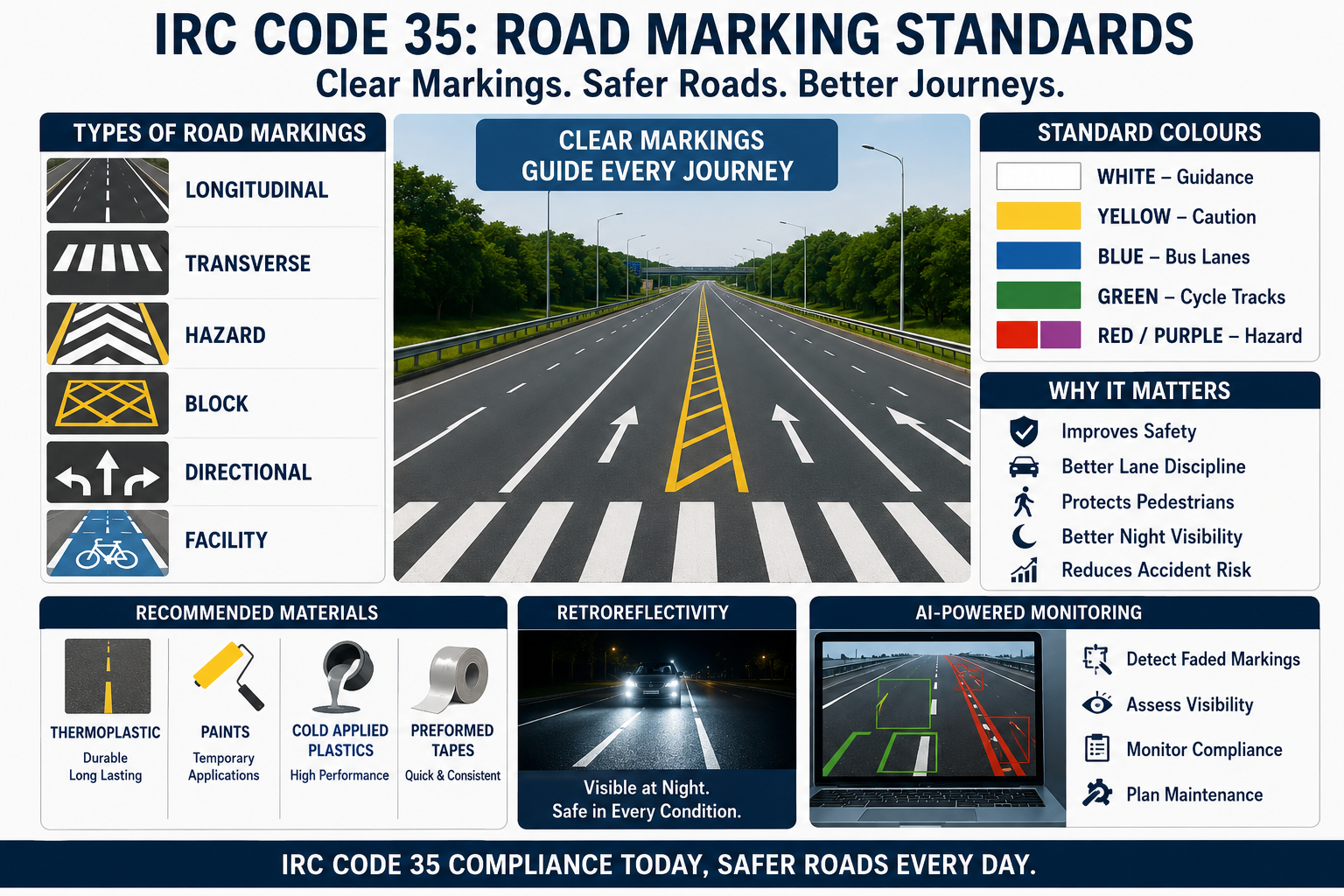
IRC Code 35, formally known as the Code of Practice for Road Markings, provides standardised guidelines for pavement markings on:
The latest revision, IRC 35:2015, reflects modern traffic conditions, improved marking materials, and enhanced visibility requirements.
The objective is simple:
Uniform markings ensure road users receive consistent visual information regardless of where they travel within India.
Road markings serve as continuous communication tools between road authorities and road users.
They become especially important during:
Properly maintained markings help:
Modern AI road safety audit India platforms increasingly include road marking assessments as a critical component of roadway safety evaluations.
IRC Code 35 classifies pavement markings into several functional categories.
These markings run parallel to traffic flow and regulate vehicle movement.
Examples include:
They provide continuous lane guidance and improve roadway discipline.
These markings are installed across traffic flow.
Common examples include:
They help regulate vehicle behaviour at intersections and pedestrian facilities.
Hazard markings warn drivers of potential conflicts or restricted areas.
Examples include:
These markings improve driver awareness in high-risk zones.
Block markings identify specific safety-sensitive areas such as:
They improve road user awareness and encourage safer driving behaviour.
Directional guidance is provided through:
These markings assist drivers in selecting the correct lane before reaching intersections.
Facility markings identify dedicated infrastructure spaces such as:
These markings support organised and inclusive transportation systems.
Material selection plays a major role in marking durability and visibility.
Thermoplastic materials remain the most widely used permanent marking solution in India.
Benefits include:
Modern thermoplastic road marking AI inspection systems help authorities monitor wear patterns and performance across large networks.
These materials are generally used for:
Although economical, they typically require more frequent maintenance.
Cold-applied plastic systems offer:
They are commonly used in high-performance applications.
These materials provide:
They are particularly useful in high-priority urban corridors.
Night-time visibility is one of the most critical performance requirements for pavement markings.
Retroreflective glass beads embedded within marking materials reflect vehicle headlights back toward drivers, improving visibility in:
Modern road marking retroreflectivity AI survey India solutions help transportation agencies continuously evaluate marking performance and identify areas requiring maintenance.
Without adequate retroreflectivity, road markings lose much of their safety value.
The code establishes standard colour usage to ensure consistency across India.
Used for:
Used for:
Used for:
Used for:
Used in:
Consistent colour coding improves road user understanding and reduces confusion.
Road markings deteriorate due to:
IRC Code 35 requires periodic evaluation of:
Modern automated road marking condition assessment systems allow agencies to inspect thousands of kilometres of roads quickly and consistently.
Traditional visual inspections often struggle to cover large road networks efficiently.
Today, AI pavement marking compliance NHAI solutions use computer vision and mobile imagery to automate compliance monitoring.
These systems can:
Advanced lane marking fading AI detection dashcam technology enables continuous roadway assessments using existing fleet vehicles without disrupting traffic.
Road markings are a key component of broader roadway safety evaluations.
Modern road safety audit road markings AI India platforms integrate pavement marking inspections with:
This creates a comprehensive approach to infrastructure safety management.
RoadVision AI helps authorities digitise road marking inspections through:
The platform supports engineers and road authorities in maintaining safer, more visible, and more compliant road networks.
IRC 35 road marking standards India provide the foundation for consistent, durable, and highly visible pavement markings across the country's transportation network.
By standardising marking categories, materials, colours, and maintenance practices, IRC Code 35 helps improve traffic discipline, reduce accidents, and enhance overall road safety.
With emerging technologies such as AI roadway safety management, AI-based infrastructure safety management, and AI infrastructure safety analysis, authorities can now monitor compliance more efficiently than ever before.
Road markings may seem simple, but they remain one of the most powerful tools for creating safer roads and more predictable traffic movement.
Because when road users can clearly see the path ahead, everyone travels more safely.
Road markings are one of the most critical elements of roadway safety, but maintaining visibility, durability, and compliance across thousands of kilometres can be challenging. With RoadVision AI, agencies can automate inspections, monitor marking performance in real time, and ensure alignment with IRC standards through AI-powered analytics.
Book a demo today to see how RoadVision AI can help you streamline road marking audits, identify faded or non-compliant markings, improve maintenance planning, and enhance roadway safety with data-driven infrastructure intelligence.
IRC Code 35 is the official Indian Roads Congress guideline that establishes standards for pavement marking design, materials, colours, application methods, visibility requirements, and maintenance practices across India.
AI-powered inspection systems use computer vision and roadway imagery to detect faded markings, missing lane lines, visibility issues, and compliance gaps while generating automated maintenance reports.
Retroreflectivity ensures road markings remain visible at night and during adverse weather conditions by reflecting vehicle headlights back toward drivers, improving guidance and reducing accident risk.
The Autonomous Road Engineer
AI-powered road condition monitoring, asset management, & infrastructure intelligence helping agencies move from reactive maintenance to predictive road management.


.webp)
.webp)
.webp)